Ischigualasto, where the dinosaurs start
San Juan's Valle de la Luna holds a complete Triassic record and some of the oldest dinosaurs ever found. How the visit actually works, and what to see around it.
By VisitCuyo Editors ·
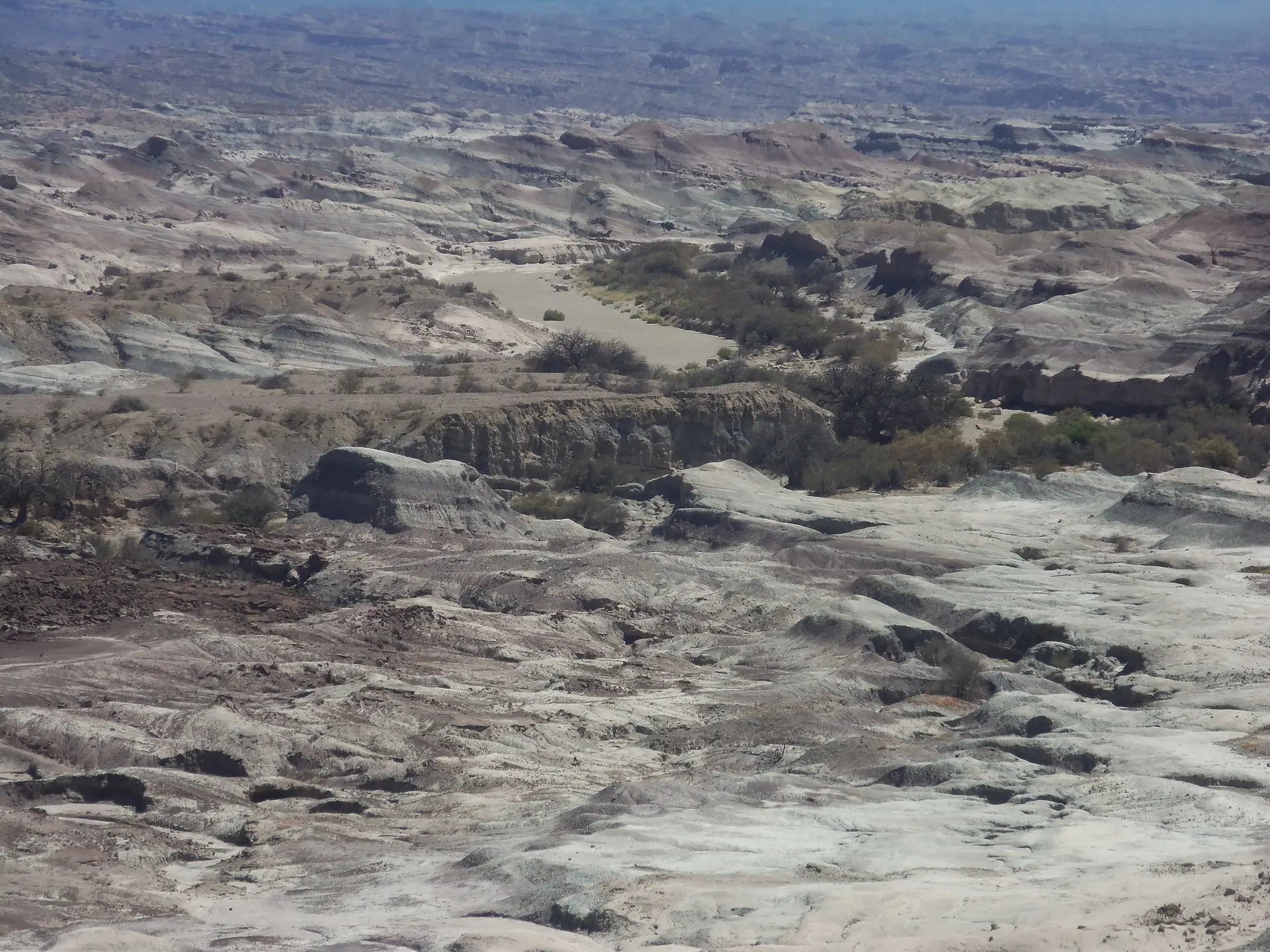
Photo: Silvanamisiones, CC BY-SA 4.0

Ischigualasto is a grey clay basin in northern San Juan where 230 million years of Triassic sediment lie exposed in order, uninterrupted. That continuity is why it is a UNESCO World Heritage site, and why Eoraptor and Herrerasaurus — among the oldest dinosaurs known anywhere — were found here rather than somewhere more obvious.
Most people come for the landscape and leave having absorbed the geology by accident. Both are fine reasons.
How the visit works
The park is not a place you wander. Visits run as a convoy: you drive your own vehicle in a line behind a ranger’s, stopping at five or six points over roughly three hours. A guide travels with the group.
A few consequences worth planning around:
- You need a vehicle. There is no public transport to the gate and nothing to walk in from.
- Departures are at fixed times, more of them in high season, and the last one leaves well before sunset.
- Full-moon night tours run monthly and book out early. They are genuinely different — the clay goes luminous — and genuinely cold.
- Bring water, a hat and sun cream. There is no shade anywhere in the park, and no water past the visitor centre.
What you actually see
The stops are named for what erosion made of them — the Mushroom, the Submarine, the Painted Valley, the Bowling Green with its improbable spherical concretions. The guiding is good on the fossil story, and the visitor centre’s small museum is worth the fifteen minutes before you set off.
The light is the thing. Midday flattens the whole basin into grey; the first and last departures are when the formations get their shadows back.
Around it
Talampaya, over the border in La Rioja, is the geological other half of the same story and the usual pairing — red sandstone canyon to Ischigualasto’s grey badland. It is about two hours away and a full day in its own right, which makes the two of them a two-night trip based in Villa Unión or San Agustín del Valle Fértil.
Valle Fértil is the practical base on the San Juan side: 80 km from the park gate, with enough accommodation and the last reliable fuel.
When to come
April to June and September to November. The park stays open in summer, but a January visit means walking an unshaded clay floor above 40 °C, and winter mornings start below freezing. Either way, go early.